

I’m excited to launch The Planning Edge — a monthly newsletter designed to help supply chain leaders stay ahead in an increasingly volatile planning environment.
Each month, we’ll share:
- Key supply chain planning trends shaping the market
- Practical insights from real-world customer projects
- New articles, webinars, case studies, and resources from New Horizon
- Strategic perspectives on how AI is changing planning, forecasting, purchasing, and inventory optimization
Our goal is simple. We want to deliver practical, high-value insights you can actually use — without the noise.
As supply chains grow more complex, planners need more than visibility. They need speed, adaptability, and systems that help them make smarter decisions faster.
I’d like for this newsletter to be a conversation. Let me know what topics are most valuable to you, what challenges your team is facing, or what you’d like us to cover in future issues.
And if you find it useful, please share it with colleagues or peers who may benefit.
What’s New
🎥 Webinar: From Reactive to Proactive Buying at GHRA
One of the biggest challenges many organizations face is moving beyond spreadsheet-driven purchasing and reactive replenishment.
In this webinar, GHRA’s VP of Supply Chain Operations and one of their lead planners share what it actually took to transition from manual purchasing to proactive, AI-driven supply chain planning.
Key takeaways include:
- The hidden operational and financial costs of reactive buying
- Why clean master data is foundational for successful AI implementation
- How improved forecasting and automation stabilize purchasing
- Lessons learned during implementation
- Real business outcomes since adopting AI-driven planning
If your organization is still spending too much time firefighting supply shortages, excess inventory, or inconsistent purchasing decisions, this session offers a highly practical roadmap.
📈 Industry Trend: Agility Is Becoming a Competitive Advantage
Mid-sized manufacturers and distributors continue to face margin pressure from fluctuating commodity prices, rising labor costs, and geopolitical uncertainty.
What we’re seeing across the market is clear.
Companies that can replan faster — weekly or even daily instead of monthly — are outperforming those relying on rigid planning cycles.
The difference often comes down to:
- Faster response to supply disruptions
- More accurate inventory positioning
- Better scenario planning
- Reduced overreaction to short-term market shifts
- Improved service levels without excessive inventory costs
In today’s environment, planning speed is increasingly becoming a strategic differentiator.
📊 Featured Article: Planning for New Realities
Traditional supply chain planning processes were not built for today’s level of disruption.
Commodity shocks, regional conflicts, shifting tariffs, transportation volatility, and changing customer demand patterns are exposing the limitations of legacy planning approaches.
Most organizations don’t struggle because they lack data.
They struggle because:
- Planning cycles are too slow
- Teams rely on outdated assumptions
- Scenario modeling is limited
- Responses often overcorrect at the wrong times
- Planning remains siloed instead of network-wide
The organizations navigating uncertainty most effectively are
- Moving from monthly to weekly S&OP
- Running scenario planning continuously
- Updating demand signals in near real time
- Coordinating decisions across purchasing, inventory, and transportation
Our latest article explores why traditional planning models break down under volatility — and what modern supply chain leaders are doing differently.
🎯 Metrics of the month
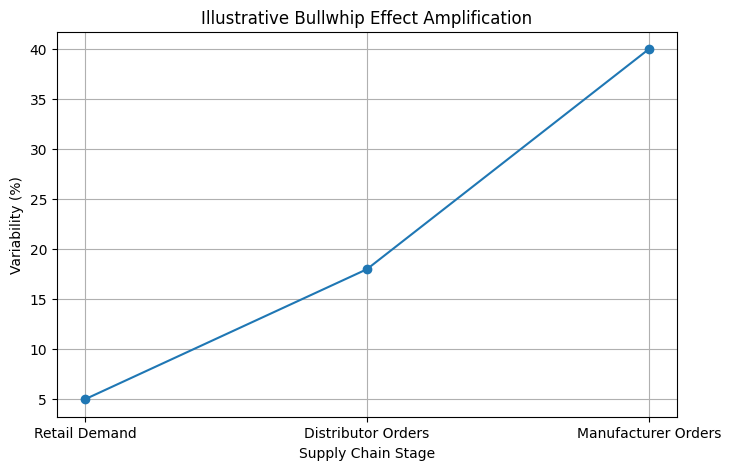
Manufacturers and distributors continue to experience the effects of what supply chain researchers call the “bullwhip effect,” where small fluctuations in customer demand create increasingly larger swings in upstream purchasing and production activity. Research has shown that a modest 5% variation in retail demand can amplify into 20–40% variability at the distributor and manufacturing levels, creating unnecessary expedite costs, schedule instability, excess inventory, and supplier disruption. As a result, leading supply chain organizations are placing greater emphasis not only on forecast accuracy, but also on forecast stability and disciplined response management. Companies that can reduce unnecessary planning volatility are often better positioned to improve service levels, lower inventory exposure, and operate with greater agility in uncertain markets.
⚡ Product spotlight: AI-powered invoice matching
Most AP teams still spend hours manually matching invoices to purchase orders and receipts. That’s time better spent on higher-value work. AP teams are increasingly under pressure to process invoices faster without increasing headcount
New Horizon Buyers Workbench now includes AI-powered invoice matching and AP automation. The system automatically reads invoices from email, extracts structured data, and performs 2-way or 3-way matching against POs and receiving records.
When everything matches, invoices get auto-approved and posted back to your ERP. When there’s a discrepancy — price variance, quantity mismatch, missing receipts — the system routes exceptions to the right person with guided workflows for resolution.
Early adopters are seeing 80-90% touchless invoice processing and cutting AP costs by more than half.
Learn more about AI-powered invoice matching.
📣 Join the Conversation
Thanks for reading the first issue of The Planning Edge.
My goal is to make this newsletter a practical resource for supply chain leaders navigating increasingly complex planning environments.
If there’s a topic you’d like to see covered in a future issue, send me a message or leave a comment on LinkedIn. I’m always looking for real-world planning challenges and questions to explore.
And if you found this issue valuable, please share it with a colleague or peer who may benefit from it.
Until next month,
Chao-Ming Ying, PhD
Co-founder & CTO, New Horizon